Skill
Essay Review
A four-pass read-only review that holds a finished essay draft against your own voice and distinctiveness standard, returning quoted, located flags instead of a verdict.
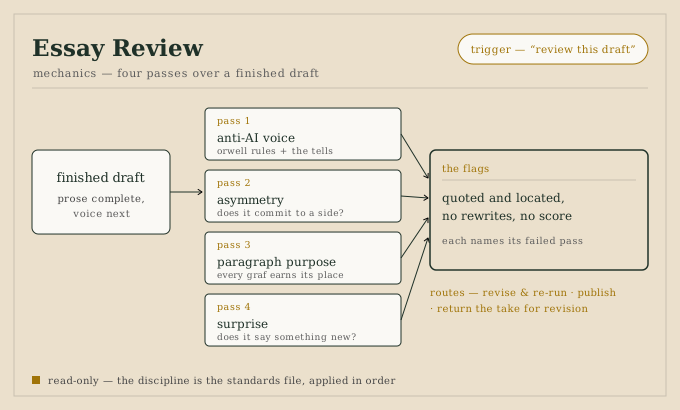
Some failure modes survive a clean first read. A finished essay can be fluent, correct, and indistinguishable from competent AI output — publishable-looking prose that still fails the only bar that matters. A single read glosses over the specific ways it fails. This skill splits the read into four passes, each aimed at one failure mode, each returning a quoted line and a location instead of “this feels off.”
It is read-only. It reads the draft and your standard files, prints a report, and stops. It never rewrites and never edits anything on disk. You decide what to do with every flag.
How it works
The standards live outside the skill — in two files it reads at runtime, so the discipline can evolve without touching the skill. It runs four passes in order, each producing its own section.
- Voice check. Reads your voice file and checks the draft against two layers: a short set of plain-prose writing rules, and a checklist of AI-tells grouped by level (sentence, structural, voice). Every flag is quoted and located — not “too many em-dashes” but “em-dash overuse in paragraphs 3, 5, 7.” The override rule holds: when a flagged violation is a deliberate, better choice, it asks rather than corrects.
- Asymmetry test. Reads the distinctiveness section of your operating spec and asks, per leg, what the draft does to make it visible. Then the negative test: what would have to be true about the author for this piece to exist? If the answer names a category the author belongs to rather than the author specifically, the distinctiveness is weak.
- Paragraph-purpose test. Walks every paragraph and asks: could this come out and the argument still works? Failing paragraphs are flagged as cut candidates by their opening sentence.
- Surprise test. Poses one question and waits for you to answer it: what did you learn writing this that you did not know going in? A substantive answer passes; “nothing, I just expressed what I already thought” means it is not done.
A final block gives the per-pass result and a recommended next move: revise and re-run, publish, or return upstream for a take revision.
Use it on
Complete drafts only — newsletters, blog posts, essays, internal memos. Re-runnable on every revision. The four-pass structure is medium-agnostic; the voice and distinctiveness standards are yours to define. If a standard file is missing, it says so and runs the passes that can.