Skill
Check Voice
A read-only audit that holds a piece of writing against a documented voice guide and reports where it drifts off-voice — quoted, attribute by attribute. It diagnoses; you fix.
Voice erodes quietly. When a product is one coherent agent and its prose is what drives it, voice drift is not cosmetic — it is the product degrading. The erosion creeps in as prompts get edited, specs get hand-ported, and completions get reviewed by eye: a spec quietly picks up “leverage” as a verb or a celebratory “Awesome!”, and that teaches the agent to speak that way. The only defense most people have is re-reading the whole voice guide from memory every time, which is exactly the drift-prone path that lets things slip.
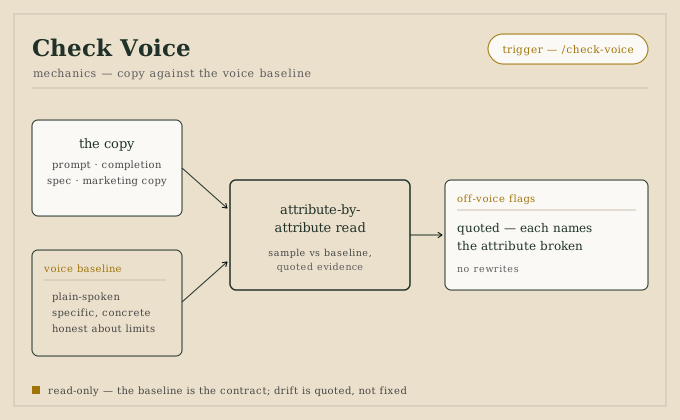
This skill makes the audit repeatable and evidence-based. It reads a piece of writing, holds it against a documented voice baseline, and reports every place the writing drifts — each finding quoted and tied to a named attribute or anti-pattern. “Feels a little off” becomes a specific line with a specific fix direction. It diagnoses only; it never rewrites and it never touches the baseline.
How it works
It runs five fixed steps over whatever genre you hand it — a prompt, a captured completion, a spec with embedded voice samples, marketing copy.
- Load the baseline. It reads two files: the tight operational voice spec the agent actually runs on (named attributes, an anti-pattern list, behavioral patterns, audience-calibration examples), then the broader voice-and-brand guide. Judgments trace to those files, not to memory — if the baseline has been edited to contradict a habitual flag, the baseline wins.
- Classify the genre. The baseline applies differently to instructions, to output, and to copy. Crucially, it does not flag scaffolding — a spec line that says “Don’t lecture” is instruction, not a violation. Only language the agent would speak is in scope.
- Scan four lenses. Anti-pattern matches against the named list; drift from each attribute (violated, served, or absent); audience calibration against a defined reader; and format-and-pacing — but only for prompts and conversations.
- Note what’s working. Two to four quoted strengths, so the next iteration does not drift away from already-validated patterns.
- Report in a fixed template, with every section printed even when the entry is “None.” — so you can see every dimension was scanned.
The discipline is restraint. It distinguishes describing a rule from speaking in voice, it quotes the writing rather than gesturing at “feels off,” and it calibrates severity — one stray “Awesome!” in a long prompt is a note; the same pattern across many lines is a systemic flag. It does not manufacture findings, because false positives erode the signal.
Adapt it
The two baseline files, the attributes, the anti-pattern categories, and the audience anchor are all yours to supply. Smoke-test it by running it on the operational baseline itself — that file is the voice, so it should come back nearly clean.