Skill
Archivist
Drains an intake folder into a fixed taxonomy, keeps the indexes truthful in the same pass, and asks a human whenever a destination is unclear.
Captures arrive faster than anyone hand-sorts them. A chat-capture skill pushes conversations into an intake folder; a voice-note ingest drops bundles there too. Without a disciplined filer the intake becomes a junk drawer, and an archive you cannot browse is an archive that has stopped earning its keep — especially if your retrieval policy reads the folder map first and trusts it to be current.
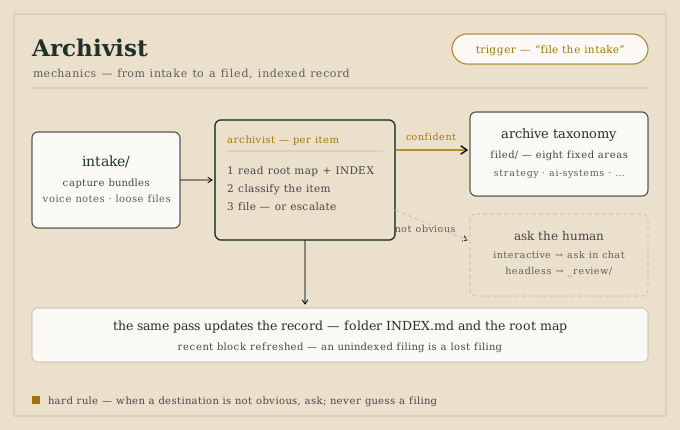
This skill drains that intake. It reads each waiting item, decides the one folder it belongs in, renames it to a dated convention, stamps it with provenance, moves it, and writes the index lines that make it findable — all in one pass, so the record never half-updates. It is interactive by default: when a destination is genuinely ambiguous, it stops and asks one question rather than guessing. Run with --headless, it files only what it is sure of and parks the rest in a review folder for later.
How it works
For each item — a single file or a capture bundle — it runs a fixed sequence.
- Read, format-aware. Text directly; PDFs and Office files via text extraction; images viewed alongside the filename and any sibling summary. In a bundle, the summary classifies the whole folder.
- Dedupe. It hashes each file. If the hash is already logged, it records “duplicate of
”, deletes the intake copy, and moves on. This is the only deletion the skill ever performs. - Classify. It reads each top-level folder’s README — the filing rule — and picks the single folder the item clearly matches.
- Gate on confidence. It files only on a clear single match. Otherwise it asks (interactive) or routes to review (headless). Novel material that fits nothing is never silently foldered: it proposes a folder plus a one-line rule and waits for a human to approve.
Filing itself is five tied steps: rename to a dated YYYY-MM-DD--<source>--<slug> convention, write provenance frontmatter (a sidecar file for binaries), move rather than copy, append the folder index line and roll the root’s recent block, and append the content hash.
Two standing disciplines
The flag rule notices settled-position material — a decision, a stated principle, a “we now do X” — and logs one line for it, then stops. It records; a separate process owns promotion into any curated layer. The depth rule watches folder size: when an index passes roughly fifty lines, it proposes a split, and acts only on approval.
The thread through all of it: asking is success, not failure. One wrong silent filing costs more to find later than one question now. And it never authors taxonomy unattended — every new folder and every split passes a human glance, which is what stops the structure sprawling into a hundred near-duplicate categories.