Skill
Archive Capture
Freezes a chat into a dated bundle — summary plus every artifact and the scripts that made them — and ships it to an archive inbox before the container evaporates.
Chat containers are ephemeral. When a web or mobile session ends, its working files — and the scripts that built them — disappear. What survives is whatever you manually downloaded, stripped of its reasoning and provenance. The output lives; how it was made does not.
This skill makes preserving a session a single instruction. It writes a short descriptive record of what the conversation covered, copies every artifact the chat produced alongside the source recipes that generated them, and pushes the whole bundle to an inbox folder in a private git repo that couriers it to your main machine for filing later. It records what happened. It does not curate settled conclusions — that is a different job, and keeping the two separate is the point.
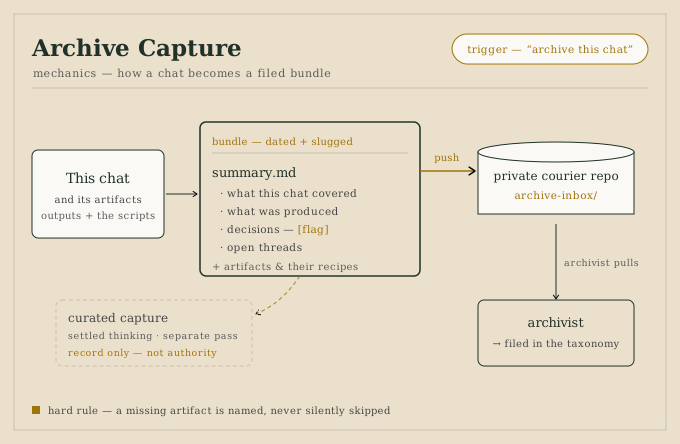
How it works
It runs five ordered steps.
- Name the bundle
YYYY-MM-DD--<short-topic-slug>, so it sorts by date and reads at a glance. - Write the summary. Frontmatter, then four fixed sections: what the chat covered (a few past-tense sentences), what was produced (one line per artifact), decisions and positions, and open threads.
- Gather artifacts. Copy everything from the outputs and working directories — and always travel the generating script next to its rendered output. If a file is gone because the container reset, say so plainly and regenerate it from its recipe; never drop a missing artifact silently.
- Ship. Shallow-clone the repo, drop the bundle into the inbox, set the commit identity, commit, push. On a rejected push, rebase and try once more.
- Confirm with the bundle name, the file list, and the real push output quoted verbatim. Success is never claimed without it.
The disciplines that matter
Two rules carry the weight. Source recipes travel with outputs — a regenerated artifact later is reproducible, not a guess. And a missing file is reported, never skipped — a noisy gap in the record beats a clean-looking bundle with a hole in it. If you direct software you cannot independently verify, an honest “this was lost, here is why” is worth more than a tidy lie.
A note on scope
The decisions section opens with a record-only marker line that flags it as history, not authority. That line is the seam to any separate settled-thinking pipeline you run: it marks what sounded settled as a candidate for later promotion, while keeping this record explicitly non-authoritative. Two captures over one conversation — one records what happened, the other extracts what you concluded — and they are built so neither imitates the other.